


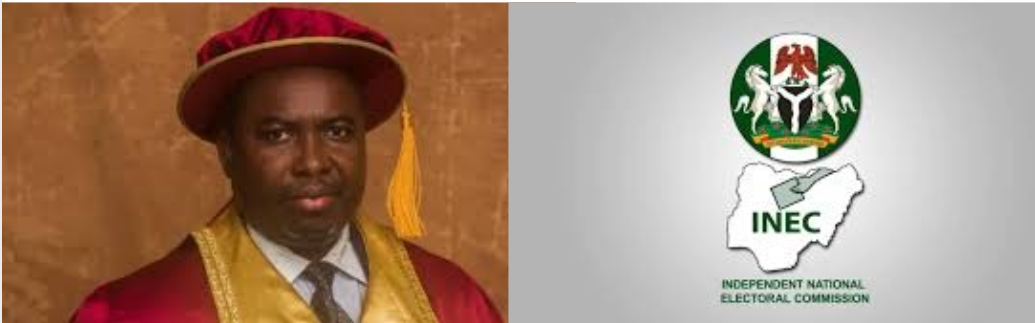
A single post on X — allegedly tweeted in 2023 — has sent Nigeria’s electoral establishment into crisis. And at the heart of the storm is a question that is no longer just political. It is fundamentally technological.
Prof. Joash Amupitan, appointed INEC Chairman by President Bola Tinubu in October 2025, is now at the centre of one of the most consequential digital controversies in Nigerian political history. The claim is straightforward: an X account bearing his name allegedly commented “Victory is sure” on a post by APC National Youth Leader Dayo Israel — a post celebrating polling unit gains for the ruling party during the 2023 elections. Opposition parties, civil society groups, and lawmakers now want him gone. INEC says the account is not his. Nigeria, ahead of a critical 2027 general election, is watching — and so is the rest of Africa.

What makes this story different from a routine political scandal is what it reveals about the collision between digital identity, AI tools, and electoral credibility in an era when social media is no longer just a communication channel. It is evidence. It is a political weapon. And increasingly, it is a courtroom.
Grok Said It. INEC Said No. Who Decides?
When the controversy first surfaced, users on X turned to Grok — the AI chatbot built into the platform — to probe the alleged account. Grok’s analysis appeared to link the account to Amupitan. That finding went viral. Within hours, screenshots circulated across WhatsApp groups, news sites, and political forums, framing the AI output as proof of the chairman’s partisan leanings.
INEC’s response was swift — and technically sharp. Lawrence Bayode, the commission’s Director of Information and Communication Technology, went on Channels Television to push back.
“Grok honestly can hallucinate just like any modern artificial intelligence system. The key is to verify important information, especially for decision or public communication. So any AI system can hallucinate, and so Grok can also hallucinate,” he said.
He also dismissed screenshots as unreliable.
“I will not base my judgments on screenshots. I will not allow that to guide my conclusion. We are going to be engaging a third party — forensic experts — to look into this,” Bayode said.
It is a technically defensible position. AI tools like Grok are not infallible. Screenshots can be edited. Digital attribution is a specialist discipline, not a social media exercise. Yet the public did not read it that way. For many Nigerians, INEC’s rapid technical rebuttal felt less like precision and more like deflection.
The Wayback Machine Disagrees With INEC
Tech expert Gbenga Sesan, speaking on the same Channels Television programme, offered a counter-argument that landed harder. He pointed to the Wayback Machine — a public web archive that stores historical snapshots of internet pages — as independent corroboration that an account under the handle “joashamupitan” once existed.
“The counter from INEC is that he never had a Twitter account. But when a public institution denies something, you have to ask more questions. Anyone can check web archives, such as the Wayback Machine, which stores snapshots of web pages over time. I found records linked to the handle ‘joash amupitan’,” Sesan said.
He also noted the structural reality of account creation. “The reality is that you cannot use someone’s email or phone number to open an account without access to verification messages sent to them,” he said, arguing that ownership could, in principle, be established through the platform’s own registration data.
The ADC caucus in the House of Representatives went further still, alleging that digital forensic analysis and open-source investigations suggest the phone number used to create the account is registered in Amupitan’s name. INEC has not confirmed or refuted that specific claim.
What This Tells Africa About 2027 and Beyond
The Amupitan controversy is bigger than one man’s social media history. It is a live demonstration of the growing power of digital trails to shape — and destabilise — political institutions across Africa. And it arrives at precisely the moment when that continent is debating how much to trust technology in its elections.
Adewole Adebayo, the SDP’s 2023 presidential candidate, framed the stakes plainly. “If it is traced to him and he denies it, then it raises questions about integrity. In a simple matter like this, if you are already lying to the public and we are to trust you with determining election outcomes, then it becomes a question of integrity,” he said.
That argument will resonate far beyond Nigeria. In Ghana, Kenya, Senegal, and South Africa, electoral bodies face versions of the same pressure: social media posts travel faster than official statements, AI tools are increasingly used to investigate public figures, and digital archives preserve records that no institution can fully erase.
The Amupitan case is, in effect, a rehearsal for what African elections will look like in the years ahead — where a comment left on a platform years before an appointment can resurface as a constitutional question. Where AI is simultaneously the accuser and an unreliable witness. Where the Wayback Machine holds evidence that a press statement cannot undo.
SERAP has since called on the National Assembly to investigate the matter through its constitutional oversight powers. Activist Mahdi Shehu, writing on X, warned that public anger is growing and that trust in INEC leadership is weakening — an observation that both INEC and the presidency have yet to formally address.
For now, INEC says its forensic experts and security agencies are working. The public is waiting. And Africa’s electoral future is watching a tweet.
