


Ile-Ife, Osun State, Nigeria—There is a quiet power in what happened between May 1st and May 28th, 2026. A CEO spoke. Nigerians pushed back. Within weeks, Moniepoint committed ₦3 billion to setting up innovation hubs in three of the country’s most storied universities.
Only Tosin Eniolorunda can tell us if he was directly responding to the criticism or if the OAU launch was already on the cards before the controversy blew up. But the order of events matters—because it reveals something the tech ecosystem of Africa must not forget. Public accountability works. Public pressure does work. And silence, in response to a false narrative, would have cost this country dearly.
How We Arrived Here
Remember May 1. Eniolorunda took to The Platform Nigeria conference to make a statement that went viral on the internet. Moniepoint, he said, had about 500 vacancies it could not fill because Nigerian applicants were simply not meeting global standards. He partly blamed social media culture, get-rich-quick mentalities and a generation distracted from the hard disciplines that forge lasting careers in technology.
The statement was not entirely untrue. The problems in Nigeria’s tech talent pipeline are real structural problems—problems that originate from underfunded universities, outdated curricula and a public education system that has let down young people for decades. These are not lies.
But Techstoriex asked a question that the nation needed to hear. If Moniepoint genuinely believed that Nigeria’s youth culture was the problem, why had the same company reportedly spent $5 million in 2023 to headline-sponsor Big Brother Naija—a reality entertainment show that, by the CEO’s own logic, epitomises the very culture of distraction and shallow ambition he was criticising? Where was the equivalent investment in coding schools? Where was the talent development infrastructure commensurate with the financial size of the company?
That piece went around. It was read by Nigerians. It generated an uncomfortable but pointed conversation in all the right ways.
Now imagine what would have happened if no one said anything.
Imagine the Silence
What if Nigerians had bought Eniolorunda’s framing without question? Imagine if the country had all agreed, yes, our youth are hopeless; yes, the talent isn’t there; yes, the problem is ours alone to carry. That narrative would have become conventional wisdom unchallenged.
Investors would have pointed to it. Recruiters would have said it again. And a generation of young Nigerians, many of them truly capable and quietly grinding in rooms nobody films, would have been written off by the very industry they are trying to enter.
The critique was not the product of envy or cynicism. It was born out of the refusal to allow a powerful person to define Nigeria’s youth without accountability. And in this case, accountability seems to have yielded something tangible.
What Moniepoint Just Committed
On May 28, 2026, Moniepoint announced a ₦3 billion investment to set up innovation hubs in three federal universities – Obafemi Awolowo University, Ile-Ife, University of Nigeria Nsukka and Ahmadu Bello University, Zaria. The programme runs for three years and was deliberately designed to spread opportunity across Nigeria’s regions, rather than concentrate it in Lagos.
Students at the three campuses will receive practical training in software engineering, artificial intelligence, robotics, product design, data science and entrepreneurship. The curriculum is built around cohort-based learning, mentorship and practical industry projects, not just classroom theory.
Participants will have the opportunity to explore internship pathways, learn from Moniepoint’s internal engineering and business teams, and build direct connections with Moniepoint’s wider network of investors and industry leaders.

Moniepoint’s CEO, Eniolorunda and the VC OAU, Prof. Bamire at the proposed site
Eniolorunda was careful in his use of words at the OAU launch. “It’s easy to forget that it all began with the foundational training we received right here in Nigerian universities when you look at the success of companies like Moniepoint,” he said. “Nigeria’s digital economy needs a huge, localised talent density; it cannot function on potential alone. We are purposefully anchoring top-notch technological capabilities throughout the nation by establishing these Innovation Hubs, starting with OAU, UNN, and ABU Zaria.”
OAU Vice Chancellor, Professor Adebayo Simeon Bamire, lauded the partnership. “Our belief that knowledge must serve society is powerfully affirmed by this partnership with Moniepoint Group. The Moniepoint Innovation Hub will not only broaden our students’ knowledge but also change their perception of what is feasible,” he said.
Those are not meaningless ceremonial words. They are a testament to what this investment, if done right, could mean to thousands of young Nigerians with talent and ambition, and no institutional backing to hone either.
Why It Matters Beyond Moniepoint
Moniepoint’s ₦3 billion commitment is not just CSR. It’s a signal, and Africa needs to get it loud and clear.
There’s no shortage of raw talent on the continent. Walk into any Nigerian university campus and you will see students building apps at midnight with patchy internet and no funding. You’ll find young engineers reverse-engineering solutions to problems that shouldn’t exist in 2026. You will find people who, given the right environment, the right tools, the right mentorship, could compete with anyone in Silicon Valley, or Shenzhen, or Berlin.
What Africa has historically lacked is not talent. It is infrastructure for talent. It’s the pipeline that takes raw potential and turns it into world-class output. It’s the organised, funded and industry-backed pipeline. The West didn’t become the tech-dominant power on genius alone. It built it on universities with billion-dollar endowments, government research grants, corporate partnerships with academia, and decades of intentional investment in human capital. Africa is just beginning that journey—and initiatives like Moniepoint’s ₦3 billion commitment, however imperfect, are part of that.
We cannot afford to be a country that exports its best minds to build someone else’s economy. It can’t afford to keep churning out engineers who learn their trade in Lagos and then spend their careers in London or Toronto or Houston. The innovation hubs will not reverse the brain drain at OAU, UNN and ABU overnight. But they sow the right seed in the right soil—in the universities where the next generation of African builders is being shaped and shaping its identity and ambitions.
There is also a geographical aspect to consider. OAU anchors the South West. UNN reaches the South East. ABU covers the North. And together they are a deliberate attempt to make this a national affair rather than Lagos-centric. This matters in a country where opportunity has long been unevenly distributed, and talented young people in Zaria or Nsukka often feel like the innovation conversation is happening without them.
The Honest Caveat
When it has been necessary, this column has criticised Moniepoint. It will not drop that standard now, just because the news is good.
Three campuses, ₦3 billion in three years. That is a significant amount. But it is a beginning, not a solution. The value of this programme will not be measured by a launch ceremony at the OAU, nor by a well produced press release. It will be found in the students who graduate from these hubs, get hired, build startups, solve African problems and eventually fund the next generation of builders.
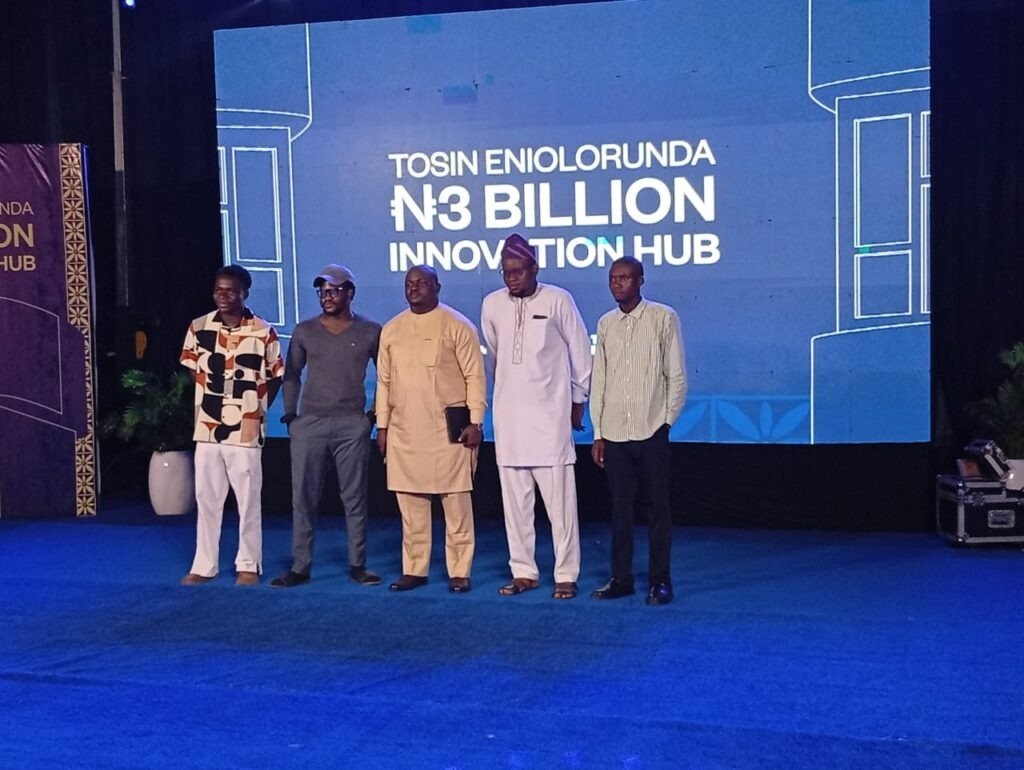
Students who won the Pitch-A-thon at the launch
It will be found in whether the curriculum remains up-to-date or becomes old. In whether the mentorship program creates real relationships or performative visits. In whether Moniepoint’s engineering teams really engage with students during the programme or disappear with the cameras. If this initiative expands to more campuses when the three-year window closes,or quietly dies the moment the PR value is used up.
This column will return to those questions. These are the questions Nigerians should keep asking—loudly, persistently, and unapologetically.
What We Are Permitted to Feel Now
For now, we are allowed to acknowledge that something moved. There was a conversation. It was uncomfortable. It was public and it seems, however imperfectly, to have contributed to a ₦3 billion decision that will impact tens of thousands of young lives.
That’s what public discourse is supposed to do. That’s what a tech media ecosystem worthy of its name is meant to facilitate. Not cheerleading for powerful companies. Not silent deference to CEOs. But honest, evidence-based accountability that nudges institutions, even the ones we admire, toward their better instincts.
Those who remained silent when it mattered will not be building Africa’s future. This is what the young engineers in Ile-Ife who walk into a Moniepoint Innovation Hub this year and learn to transform their ideas into products will build. The Nsukka student that lands her first industry mentor through this programme will build it. It will be written by the Zaria developer writing his first production-grade code inside a hub that did not exist six months ago.
Eniilorunda’s critics didn’t build those hubs. But the pressure made them open.
Now, let’s make sure they live.
