


In July, the Federal Ministry of Communications, Innovation and Digital Economy did something Nigerian regulators rarely do: it admitted, in public, that its own agencies were tripping over each other. Minister Bosun Tijani ordered the Nigerian Communications Commission, the National Information Technology Development Agency, and the Nigeria Data Protection Commission to shelve a set of overlapping internet-platform rules until a “unified” framework could be built. A joint technical committee was announced. The language was collaborative, almost apologetic. Nobody was blamed. Nothing was cancelled outright, only deferred, “pending harmonisation.
On the surface this looks like a textbook case of bureaucratic housekeeping: three agencies discovered they were writing similar rules for the same platforms and agreed to stop duplicating effort. That belief is not wrong,just incomplete. What the pause actually reveals is the opening move in a much larger contest over who gets to govern Nigeria’s digital economy for the next decade, and the answer, if current signals hold, is that one agency is about to win almost everything.
The Quiet Ambition Behind the Truce
NITDA’s 2022 Code of Practice for platforms already requires companies with more than 100,000 Nigerian users to incorporate locally, appoint country representatives, and take down flagged content within 24 hours. The NCC’s draft Internet Code of Practice, released in December, covered much of the same ground from a telecoms angle. The NDPC, meanwhile, has its own mandate over how platforms collect and move personal data. Three agencies, three legal bases, one set of companies caught in the middle, that is the immediate mess Tijani’s directive addresses.
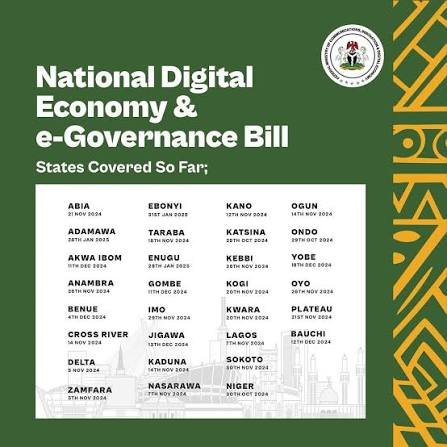
But hovering above this truce is the National Digital Economy and E-Governance Bill, expected to pass sometime this year. If enacted as currently anticipated, it would formally position NITDA as something Nigeria has never quite had before: a super-regulator for the entire digital economy, with the power to classify AI systems by risk tier, mandate algorithmic transparency, and accredit the auditors who police AI compliance. That is not modest housekeeping. That is a consolidation of regulatory authority on a scale that would make NITDA, in digital matters, something closer to what the CBN is in finance.
Seen through that lens, the harmonisation pause looks less like three agencies discovering redundancy and more like a controlled clearing of the field. You do not build a coherent, centralised framework by leaving overlapping rulebooks in place. You pause them, study them, and then decide which agency absorbs which powers. Harmonisation, in this context, is not neutral. It is a precondition for consolidation, and consolidation has a direction — toward NITDA.
Why This Matters More Than the Press Release Suggests

Nigerian technology businesses have spent the better part of a decade building around regulatory ambiguity, filling gaps left by agencies that didn’t quite reach into digital spaces, or that reached in with rules too vague or too unevenly enforced to constrain much. That era is closing. The Nigeria Data Protection Act, the Startup Act, an expanding NITDA licensing regime, a revised tax framework that now treats significant economic presence as a basis for taxing non-resident digital platforms, each of these has arrived in the past few years as a separate thread.
The E-Governance Bill would braid them into something closer to a single rope, held by a single hand.This should concern founders less because of what it restricts today and more because of what concentrated authority tends to do over time. A regulator with the power to classify AI systems by risk and accredit the auditors who assess compliance is a regulator that can shape, by administrative fiat, which companies get to operate cheaply and which get buried in compliance cost.
That power can be used well. Singapore’s Infocomm Media Development Authority shows that a single strong digital regulator can coexist with a thriving startup sector. But Singapore’s authority operates inside a state with unusually low tolerance for regulatory capture and unusually high administrative capacity.
Nigeria’s agencies, NITDA included, on the other hand, do not yet have a comparable track record of insulating rulemaking from political and commercial pressure.NITDA’s own institutional design should give founders more pause than the ministry’s statement lets on. This is an agency whose founding mandate is to *promote* IT adoption and the digital economy, it runs innovation hubs, accreditation schemes, and startup-facing programmes through arms like the Office for Nigerian Digital Innovation. Asking that same agency to also serve as the digital economy’s primary disciplinarian, with power over AI risk classification and auditor accreditation, folds promoter and regulator into one institution.
That is not a hypothetical conflict. It is the everyday tension any agency faces when its budget and political relevance depend partly on showcasing a growing digital sector, while its new mandate requires it to constrain that same sector when convenient. The 2022 Code of Practice offers a preview: enforcement has been visible mainly against large foreign platforms, while compliance among smaller domestic players has been uneven and rarely tested. A super-regulator inherits that unevenness at a larger scale, not a cleaner one.There is also a harder question the harmonisation announcement does not address: coordination between three agencies is difficult enough. Coordination that ends with one of those three agencies absorbing much of the others’ authority is a different exercise entirely, and it will not be resolved by a technical committee meeting quietly for a few months. NCC and NDPC did not build their mandates to be handed over, and neither has shown particular enthusiasm for the arrangement beyond the diplomatic language of the joint statement. Expect friction that the ministry’s talk of “one coherent voice” does not yet acknowledge, and expect NITDA, as the clear beneficiary of the proposed bill, to be the least neutral party in a process being framed as neutral.
What to Watch
The real story here is not the pause itself but what fills the vacuum it creates. Founders and operators should be watching three things: whether the E-Governance Bill’s super-regulator language survives legislative drafting intact, whether the bill separates NITDA’s promotional functions from its new disciplinary ones or simply stacks them on top of each other, and whether NCC and NDPC quietly resist ceding ground once the joint committee’s recommendations land.
None of this makes NITDA a bad-faith actor, its officials would likely argue, not unreasonably, that a fragmented regulatory field has its own costs, and that somebody has to hold the pen. But an agency being the natural candidate to write the rules is not the same as that agency being the right one to also police them without check.
Nigeria’s digital economy has operated for years on regulatory fragmentation that, whatever its costs, also left room to build. What comes next may be more coherent. Whether it is also more accountable is the question nobody currently steering the process has been asked to answer.
