

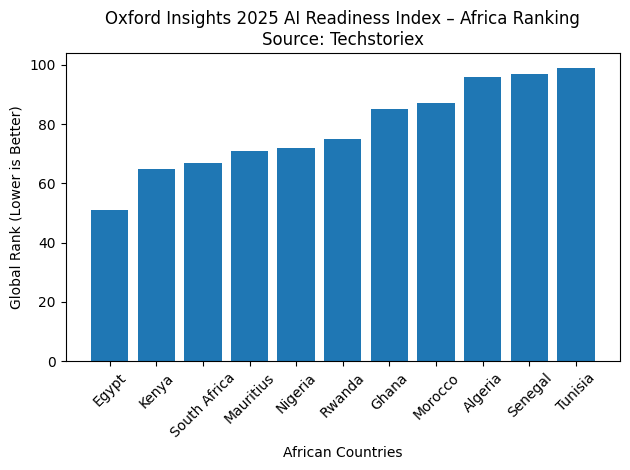
According to Oxford Insights, Nigeria ranks 72nd globally in AI readiness. It is important to figure out how before rejecting this as yet another global ranking; you would think about what it measures and why that is of importance to your day-to-day life.
What Does “AI Readiness” Actually Mean?
AI readiness has nothing to do with the number of robots walking in the streets of Lagos, or does it have to do with Siri speaking Pidgin English? The Oxford Insights Government AI Readiness Index is a system that assesses nations based on three pillars, which are essential and crucial in assessing how a country would be able to embrace and utilise artificial intelligence.
First, there is governance and infrastructure: This looks into the presence of the fundamental digital infrastructure of a nation, such as a stable internet, data protection laws, domestic AI policies, and the government’s ability to enforce technology policies. Consider it an act of ensuring that your house has power and plumbing before you install smart home devices.
Second, skills and education: Is AI accessible to the population? Are there AI graduates in universities? Investment in digital literacy? The country may possess the finest AI technology in the market, but without individuals capable of utilising it, it is just like owning a car without knowing how to drive.
Third, the data ecosystem and digital government services: To what extent does the government digitize services? Is information available to innovation and maintaining privacy? Does the data infrastructure required to develop AI solutions exist for businesses? Our 72nd place indicates that we are not at the very bottom but there are 109 countries below us, yet we are not at the level we should be to compete in an AI-driven global economy.
Why Should Everyday Nigerians Care?
You might be moved to believe that artificial intelligence is just for the tech bros in Lagos or Abuja. As a matter of fact, AI preparedness has an impact on each Nigerian, regardless of whether it is in Kano, Port Harcourt, or a village.
Your job depends on it: According to the World Economic Forum, AI will remove 85 million jobs worldwide and create 97 million jobs by 2025. Here’s the catch? The new jobs demand AI-based skills. Failure to prepare Nigeria with AI means that our young people will be denied these opportunities as they compete with the workers of other countries ranked higher in the world.
Take, for instance, when remote contracts are awarded to Indian or Kenyan developers at the expense of Nigerian talent, AI readiness is often the differentiator.
AI enhances healthcare accessibility: Overall, imagine a clinic in a rural setting, where a doctor can diagnose malaria, tuberculosis, or other illnesses using only a smartphone camera with the help of AI.
Nations that are more prepared in AI are already implementing these instruments. Our low score indicates our inability to scale such innovations throughout our healthcare sector in Nigeria, which implies that millions of people have to wait longer to get a diagnosis or further to receive specialized treatment.
Education becomes more accessible: Even in regions where there are teacher shortages, artificial intelligence (AI)-driven personalized learning systems can deliver instruction to students at their own pace, in their native languages. Unless the infrastructure, policies, and skills in terms of AI preparedness are in place, we cannot implement these solutions on a large scale.
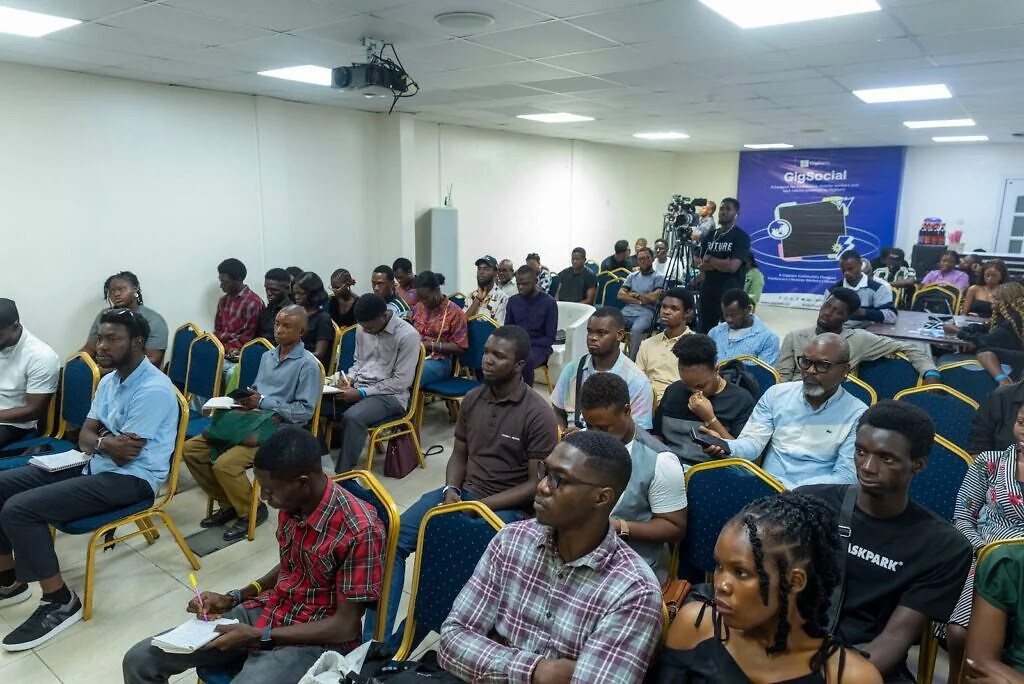
Freelancers during the Gigconnect 2025 Networking Fest
Economic growth accelerates: According to McKinsey, AI would add up to 15.7 trillion to the global economy by 2030. The profitability of Nigeria is directly related to our AI readiness. Whether it is agriculture (AI is capable of forecasting crop yields and optimizing farming) or financial services (AI can identify fraud and increase access to credit), all areas have an advantage when the base is solid.
Related Story: Tech Experts Urge Creatives to Adopt AI for Sustainability
What Would It Take to Move Up?
Rising up to the top 70 or 50 isn’t about magic; it takes practical measures. The following would make a difference:
Continuous investment in digital infrastructure: In some parts of Nigeria, internet receptivity is a big challenge and the cost of internet is high. The government and the private sector should come together this year to develop fiber optic networks, find means to lower data costs, and bring even the rural regions on board in terms of solid internet connectivity. No other thing matters without this foundation.
Create clear AI policies and regulations: What we need in Nigeria is an AI-strategy that contains a practical approach, a feasible feedback system and accountability. There’s nothing political about this move. We also need data protection measures that individuals can trust, ethical standards for their proper use and regulations that encourage innovation.
Nations who currently sitting far above us didn’t do so overnight. They started, learned the ropes and improved along the line. The earlier we hop on the ropes, the sooner we master the ropes with smart strategies.
Promote digital literacy: Digital literacy should be promoted just like reading and writing. Universities need an updated curriculum to produce AI engineers, data scientists and also machine learning experts. This does not imply that everyone will be turned into coders, but that every single student should learn how to leverage om AI tools in their chosen field of profession. Technical colleges need to provide vocational training in AI in order to apply it practically.

Digitizing government services: Any government service that is digitized demonstrates competency. From the tax system, like the ongoing tax reforms, which have seen the FIRS have to upgrade its website to improve the system in 2025, digitization of the healthcare system, all these build the ecosystem needed for AI adoption. Access to government services online by citizens through a dependable channel is an indication that the nation has the infrastructure and governance to support more complex AI applications.
Related Story: Is The 3MTT Revolution Delivering on Renewed Hope?— Tracking Bosun Tijani’s Brainchild, Two Years On
Support local AI innovation: It’s high time the government starts supporting local AI startups. Establish innovation hubs, provide tax incentives, not harsh tax laws, in a developing country like Nigeria and establish grants and funding. These investments will no doubt yield returns, boosting the country’s economy and giving Nigeria a strong edge in the AI ecosystem. By developing AI solutions to Nigerian problems, Nigerian companies create employment and show their abilities that can bring more investment.
The Bottom Line
Ranking 72nd isn’t failure, but it is a wake-up call to Nigeria. Each rank we ascend provides employment to our youth, improved healthcare to our families, enhanced education to our children and more prosperity to our economy. Whether AI will change the world or not is already a question. That is, whether or not Nigeria will be a producer and recipient of such transformation or just a consumer of solutions constructed elsewhere.
The steps that can be taken practically in order to go up are evident. The only thing we require now is the political determination to commit, the time to develop systematically and the urgency to begin now. We are ranked according to our preferences. Enhanced decisions will result in enhanced rankings–more importantly, improved lives of ordinary Nigerians.


I am passionate about crafting stories, vibing to good music (and making some too), debating Nigeria’s political future like it’s the World Cup, and finding the perfect quiet spot to work and unwind.



No Comments