

Lagos, Nigeria – When Nigeria’s first National Telecom Policy was instituted in 2000, mobile phones were expensive, the internet was new, and the prospect of banking on a mobile device seemed implausible. 26 years later, the same policy, with minor updates, is still implemented despite 177 million subscribers generating 1.2 million terabytes of internet traffic every single month.
The Nigerian Communications Commission has acknowledged that the policy is old and outdated. Last Monday, they released a sweeping consultation paper and a proposed National Telecom Policy for the first major changes to Nigeria’s telecommunications since the introduction of GSM.
The Policy That Changed Everything
To know why the review is necessary, one has to appreciate what the original policy accomplished. In 2000, Nigeria’s telecommunications industry was characterized by empty promises. Nigerian Telecommunications Limited (NITEL) was a state-owned monopoly and had what the NCC described as “obsolete equipment, poor quality of service and low teledensity” – and was in every other sense a monopoly by virtue of poor competition. As a result, the country had a teledensity of 1:440 and getting a phone line could take a customer up to and over a decade.
Everything changed with the National Telecommunications Policy 2000. For the first time in the history of the telecommunications industry in Nigeria, NITEL’s monopoly was dismantled, competition was introduced, and the foundation was laid for the 2001-2002 GSM licensing era. The effects were incredible. There was a sudden surge in mobile subscriptions, unprecedented foreign investments, and for the first time, Nigeria’s telecommunications sector experienced real economic growth, contributing 14% to the country’s GDP.
Dr. Aminu Maida, Executive Vice Chairman of NCC, had this to say in the consultation document: “The policy didn’t just transform telecommunications—it created the foundation for Nigeria’s entire digital economy. But just as the 1998 policy became obsolete, we must acknowledge that the 2000 framework can no longer guide us through the challenges we are facing today.”
Reading Between the Lines: The Policy is Outdated
The consultation document does not seem to indicate how obsolete the policy is, but close reading suggests otherwise. Take for instance Chapter Five, which is exclusively dedicated to the ‘Restructuring and Privatization’ of NITEL, which, as everybody knows, was completed more than a decade ago. NCC describes the chapter as a transitional phase that has been completed, and so there is a disconnect between the policy and the current realities.
An example of this negligence is the policy’s treatment of the Internet. The Internet has four specific strategies. These strategies include the promotion of “fast and reliable Internet access” and advocating Internet utilization in “health, agriculture, education, and research.” This is so vague that they could mean anything or nothing.
Additionally, one of the policy’s original short-term objectives aimed to provide “at least 1,200,000 mobile lines in two years.” As of now, Nigeria has 177 million mobile subscribers, which makes that target seem quite dated.
The Overhaul: 15 Proposals to Drag Policy Into 2026
The NCC is proposing changes made to almost all facets of the policy and grouping these into 15 proposals.
The regulator intends to remove the entire chapter on privatization and instead include one on “Manpower and Capacity Development.” This is a clear acknowledgement that Nigeria’s telecom sector is in need of skilled manpower. This is further reinforced by the policy impact analysis carried out by the Ministry’s technical committee, which identifies a growing deficit of the desired level of capacity, especially as the sector begins to adopt 5G, artificial intelligence, and other high-level technological advancements.
In Chapter Seven of the document. The Internet will be updated completely. The new version will focus on content moderation, online safety, responsibility of platforms, and the governance challenges of big tech in Nigeria. This puts Nigeria in line with global developments – for example, the European Union’s Digital Services Act, which imposes stronger obligations on online platforms for the protection of users.
Nonetheless, the consultation paper is silent on how Nigeria would regulate the balance between platforms and freedom of expression, particularly whether Nigeria would opt for a more stringent approach, as some countries have, or a more liberal one.

Men working on a 5G Tower
The Satellite Question: Nigeria’s satellite communication chapter will be redrafted to address what the NCC describes as ‘cohabitation between terrestrial and non-terrestrial services.’ This is a complex way of describing a real problem: Starlink and other broadband satellite internet systems are emerging, which completely bypass the traditional telecom systems. How should regulators approach these services? Are they eligible to contribute to the universal service fund? What other spectrum management rules are applicable?
These questions are no longer theoretical. Starlink began operating in Nigeria in 2023, and its rapid growth has raised issues of the competing interests of fair competition and the conflict of regulation.
The Money Problem: No chapter needs updating more than Chapter Ten on Financing and Funding. The draft policy offered incentives such as tax holidays and pioneer status to capture investors, which worked exceptionally well in the early 2000s.
Telecoms operators have to deal with devastating foreign exchange losses, multi-layered taxation (federal, state, and local), and a high rate of inflation, making long-term planning impossible. The biggest telecom operator in Nigeria, MTN, lost ₦177 billion due to forex in 2024.
While the NCC recognizes these “fiscal and monetary challenges,” there isn’t much of a roadmap to address the challenges. The regulator is asking stakeholders for recommendations on “appropriate monetary and fiscal support,” which is a disingenuous way of stating that the regulator has no solutions.
A New Chapter: Infrastructure and the RoW Wars
The most daring proposition is for a completely new chapter on broadband goals, protection of critical infrastructure, and, most contentiously, the aligning of Right of Way charge harmonization across all tiers of government in Nigeria.
Fees associated with the Right-of-Way (RoW) have become an area of concern for many stakeholders in the Nigerian telecommunication industry. When an operator intends to deploy a fiber optic cable, they have to deal with multiple federal, state, and local government requirements, and each of them has a unique fee for the permits. Some local governments have RoW fee structures that make the deployment of new telecommunication infrastructure economically impractical.
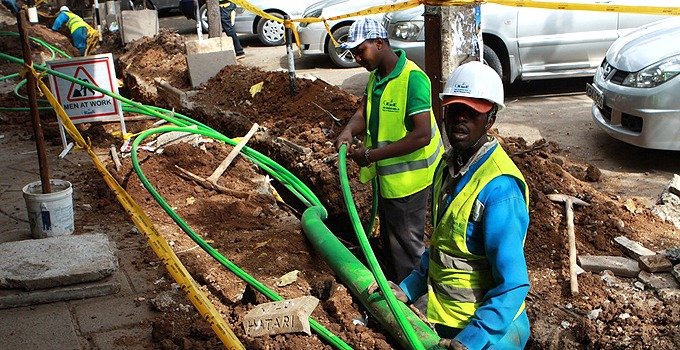
In 2013, the Nigerian Federal Government established a National RoW fee of ₦145 per meter. Most state and local governments have continued to defy this order. A decade later, it has continued to worsen, with RoW fees of ₦500 to ₦4,500 per meter being reported. These fees have been the top three to five complaints from telecommunication operators.
The “one-stop permitting process” sounds great in theory. It asks state and local governments to give up a stream of revenue that has been profitable. It is unknown if they will shift their thinking.
What is Missing: The Gaps That No One Is Mentioning
Even with all the work that has been put into this, the consultation paper lacks several components. There is no mention of the governance of artificial intelligence, even though its role in network optimization, customer service, and fraud detection is growing. The requirement for data to be stored locally is a glaring oversight. Environmental sustainability receives no attention, and neither do the objectives of ‘Green ICT’’ even though there is a significant carbon footprint from the telecommunications sector.
In regulatory conversations on spectrum management, it is clear there is a focus on harmonization between satellite and terrestrial services. There seems to be a lack of interest in several other issues, i.e., the pricing of spectrum, spectrum auctions, and the efficiency of spectrum sharing technology.
The International Benchmark Test
How does Nigeria’s approach compare with peer developing markets? The answer is mixed.
India’s telecom policy has been reformed twice, the latter being the National Digital Communications Policy. This was also the case for Kenya, as its ICT policy was updated in 2019. South Africa has documents that are regularly updated and living policies. On these counts, Nigeria’s 26-year gap is an outlier.
That said, Nigeria’s policy consultation appears robust. The 30-day period for public comment and the structured feedback template, in combination with the multi-stakeholder approach, are described as best practices for policy consultation from OECD countries. Also, the NCC seems to have learned from the 2014 National Broadband Plan, which is believed to have failed due to a lack of adequate stakeholder engagement.
“The quality of the consultation process matters as much as the policy itself,” says Dr. Uche Orji, a telecom policy expert at the Lagos Business School. “If the NCC really wants to improve things by incorporating stakeholder views, we could see a huge difference. If this is an exercise in just checking a box, we will get another document that will sit on the shelf.”
What It Means For Everyday Nigerians
What will the policy review mean for Nigeria’s 200 million citizens? Will my data become cheaper? Will the village finally get internet? Will I be safe on the internet? Will I be able to access more jobs in the digital economy?

Nigerians on the streets of Lagos
If the RoW harmonization succeeds, constructing mobile network infrastructure could become 20-30% cheaper, leading to lower retail prices for mobile data. For the first time, the Expanded Universal Service Provisions could provide actual broadband access—not just weak 2G— to underserved areas. Improved competition management could improve quality of services and curb anti-competitive behavior. Additionally, the local content development chapter is expected to generate thousands of jobs in the tech industry.
The proposed Cybersecurity Integration and Platform Accountability measures would enhance consumer protection by eliminating fraud, disinformation, and dangerous materials, and would improve the safety of digital space in Nigeria.
Nigeria has had a troubled and, in many cases, disappointing history when it comes to implementing policies. Many good policies have been rendered ineffective, and even plans such as the National Broadband Plan 2013-2018, which predicted a 30% broadband penetration goal by 2018, have still not been achieved years later. Policies certainly identify issues, such as the problem of multiple taxations, but do not have the necessary enforcement mechanisms to deal with those issues.
The overlapping regulatory powers of the NCC, National Information Technology Development Agency, National Broadcasting Commission and several others, will pose a significant challenge to the successful implementation of any plan. There is also the likely scenario that state and local governments will not comply with any harmonization of the Right of Way (RoW), as they will view it as the federal government overstepping its boundaries and infringing upon their revenue streams.
Policy implementation also will likely not solve the numerous macroeconomic challenges Nigeria faces, such as the volatility of foreign exchange, inflation, and rising fiscal pressures that make any investment in the telecom industry extremely risky.
Final Thoughts
It is fair to say that the review of the National Telecommunications Policy is necessary, timely, and well considered. The NCC has rectified genuine concerns and put forth viable solutions, and this time the consultation process is more likely to reflect serious attention.
Implementation of policy frameworks is key and Nigeria has great policies, albeit only on paper. Are we really questioning if the NTP 2026 will be better than its predecessor? We know it will be and the real question is if it will be followed at all.
All interested parties are invited to submit their comments by March 20. If you are interested in Nigeria’s digital future, this deadline is important to you, as it gives you the opportunity to influence the policies that will govern telecommunications for the next 30 years and, God forbid, until 2052, when the next policy review is due.


I am passionate about crafting stories, vibing to good music (and making some too), debating Nigeria’s political future like it’s the World Cup, and finding the perfect quiet spot to work and unwind.



No Comments