

Dr. Janet John*, an academic at a private university in Oyo State, bemoans the state of the publishing industry in Nigeria. ” It is those of us academics who have to publish books as a matter of necessity that have been hit the hardest. Students don’t buy books anymore. The internet has made it such that whatever is in your book can be found on the internet. So there is no incentive for us to publish books anymore.
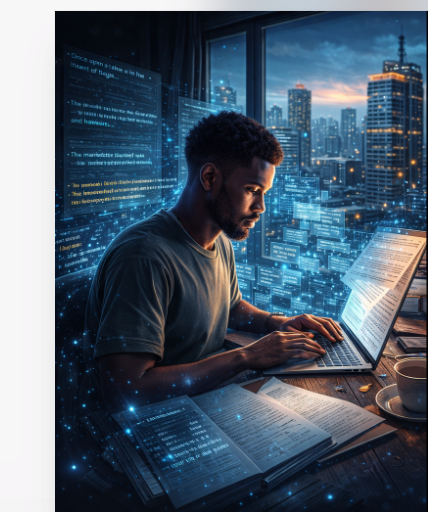
There is a particular kind of anxiety that settles over an industry when it realises the ground has shifted beneath it. For many writers and readers who for long have held the belief that, the only form of authentic writing is the paper book, they are anxious about the future of writing and publishing industry that has spent decades wrestling with high production costs, infrastructure gaps, and a reading culture long battered by economic hardship. Now, it must also reckon with artificial intelligence — a force that is simultaneously a promise and a provocation.
To understand what is at stake, you have to first understand just how fragile the Nigerian publishing ecosystem already is. “We are in an age in which the book is competing with necessities. It is inevitably a losing battle for the book.” Dr Janet muses. A novel that costs ₦8,000 in a Lagos bookshop represents a luxury item for most households. Publishers operate on thin margins, small print runs, and a distribution network that barely reaches beyond the urban centres of Lagos, Abuja, and Port Harcourt. Writers, even celebrated ones, routinely earn royalties so modest they are more symbolic than sustaining. Into this already strained landscape walks AI — and it is not walking quietly.
The Machine That Writes
Dr. Tunde Maxwell*, another academic at a public university in Osun state, says that the AI revolution, which admittedly is a negative from the book sales perspective, has been liberating. “I get work done faster, and it has opened several more research frontiers for me. It is very liberating.” It is not just researchers who can benefit from AI. A journalist on deadline can use AI to draft structures. A novelist can use it to generate filler scenes, summarise research, or push through writer’s block. A children’s book author can commission quick iterations of story ideas before settling on the best version. In these applications, AI becomes what the African Publishers Network chairman Lawrence Njagi described at the 2024 Ghana International Book Fair as a tool to “cautiously integrate” — something that, used well, can extend human creativity rather than replace it.
But the word “cautiously” is doing a lot of work in that sentence.
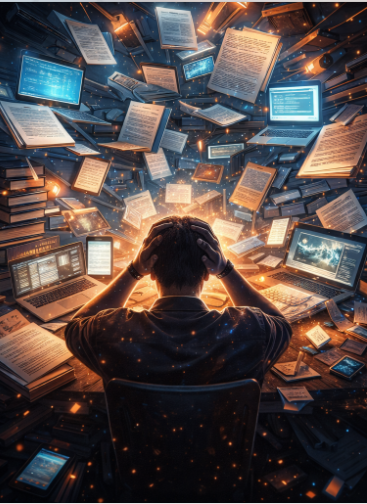
Because AI does not simply assist creativity — it also floods the market with content. Already, on global platforms like Amazon’s Kindle Direct Publishing, AI-generated books — many of them poorly written, culturally thin, and algorithmically optimised — are swamping discovery queues and suppressing the visibility of authentic human work. For a Nigerian writer trying to reach international audiences with their debut novel, competing with an entity capable of producing 50 books a week is not competition. It is erasure.
Where the Friction Lives
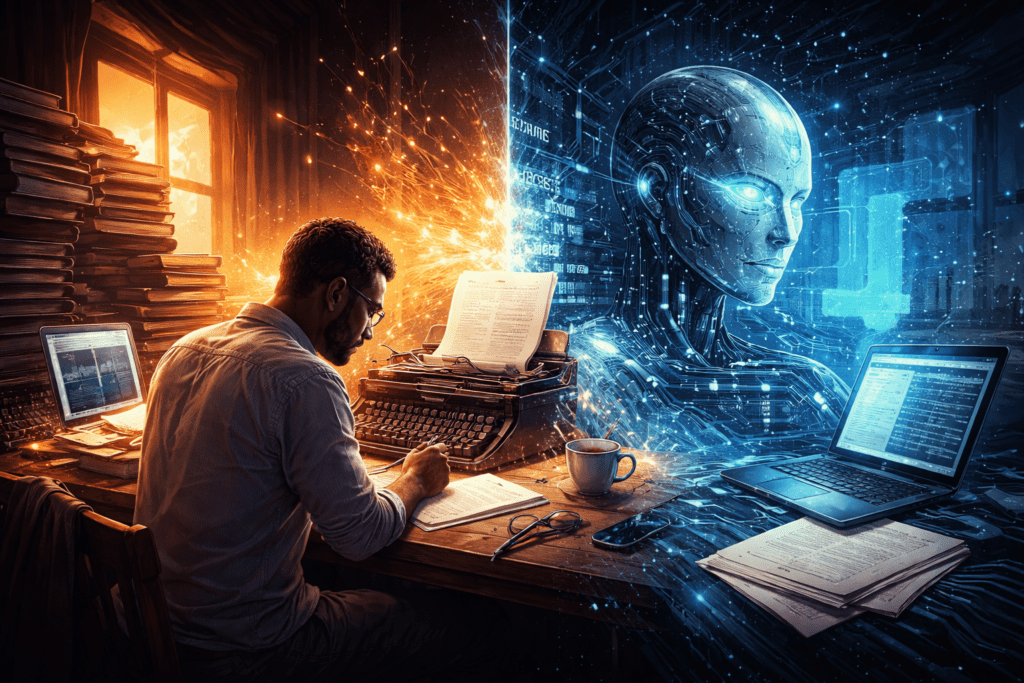
The deepest fault lines are around copyright and authorship, and they cut in two directions simultaneously.
The first direction concerns what AI takes. Large language models are trained on vast quantities of text scraped from the internet — and much of that text was written by humans who gave no consent for its use. Nigerian authors whose essays, stories, and blog posts circulate online are, in all likelihood, part of the training data that makes these models functional. Their voice, their craft, their cultural specificity — absorbed and distilled into a machine that now competes with them. Nigeria’s copyright framework, the Copyright Act 2022, grants creators exclusive rights over reproduction and distribution of their works, but it does not currently include specific provisions for text and data mining, which is how AI companies justify their training practices. Legal scholars have argued that this gap leaves Nigerian writers uniquely exposed, their works consumed without compensation, consent, or credit.
The second direction concerns what AI produces. Under the same Copyright Act 2022, protection applies exclusively to works with human authorship. AI-generated content, in its pure form, belongs to no one — or potentially to the developer of the tool, or the user who prompted it. This creates a strange paradox: the content a machine generates using a Nigerian author’s voice and style has no clear owner, while the human whose creativity it mimics receives nothing. Globally, the confusion is playing out in courts. In 2025 alone, dozens of significant copyright cases pitted publishers and media organisations against AI developers, with outcomes that remain mixed and precedents that are far from settled.
For Nigerian publishers, the royalty question is equally urgent. The traditional publishing agreement — an advance against royalties based on sales — assumes a world where book production is labour-intensive, and content is scarce. AI disrupts both assumptions. If content is cheap and abundant, what is a manuscript worth? If AI can be used to rapidly produce educational textbooks that undercut a publisher’s catalogue, who absorbs that loss? Publishers who have already thin margins face the prospect of a market where the cost of generating a book approaches zero, but the cost of paying a human editor, designer, or marketer remains stubbornly real.
What Can Actually Work
None of this means the conversation has to end in despair. But it does mean that both writers and publishers must think strategically, rather than defensively.
For writers, the most durable defence against AI is also the most obvious: depth of cultural specificity. A model trained on generic internet text cannot authentically render the texture of a Benin City street, the subtext of a family gathering in Kano, the exact cadence of Pidgin as it sounds in a Delta riverine community. Nigerian writers who root their work in this granular specificity — in what only lived experience can produce — are building something AI cannot replicate on demand. Voice, perspective, and cultural authority are not just aesthetic choices; they are competitive advantages.
Writers also need to engage with the legal landscape rather than wait for it to catch up. Professional associations like the Association of Nigerian Authors should be pushing for amendments to the Copyright Act that introduce text and data mining provisions with opt-out mechanisms, and that clarify the liability of AI developers who profit from ingesting uncompensated creative work. Nigeria has a chance to design a legal framework that is not simply borrowed from Western jurisdictions but is tailored to protect an ecosystem where creators often lack the resources to litigate.
For publishers, the path forward lies in repositioning — from being primarily manufacturers of books to being curators of trusted creative experiences. A publisher’s value has never really been the paper and ink; it has been the editorial judgment, the cultural credibility, and the relationship with readers. AI cannot replicate the trust that a respected Nigerian imprint signals to a reader. There are already publishers like Masobe Books who are investing in brand equity, with their direct-to-reader digital bookshelf, which they launched this year. Initiatives like that keep more margin in the ecosystem, and can ensure that the publishing business enters its next stage of business survival..
There is also room for practical collaboration between the two sides. Publishers and writers together can advocate for collective licensing schemes — similar to what performing rights organisations do in the music industry — where AI developers pay into a fund that compensates creators whose work was used in training data. This model already exists in parts of Europe and is being debated in the United States. Nigeria’s creative sector, including Nollywood and the music industry, has demonstrated that it can mobilise collectively. The book world should not be an exception.
The Longer View
Technology has reshaped publishing before. The printing press, the paperback, the e-reader, the PDF — each one promised disruption and delivered transformation instead. The question was never whether writing would survive, but what form the relationship between writer, publisher, and reader would take on the other side.
AI is a more complex rupture than any of these predecessors, because it does not simply change distribution — it enters the production process itself. But it is also not magic. It cannot originate. It cannot care. It cannot carry the moral weight of a story told from inside an experience. The Nigerian writer who sits down to make sense of their world — its contradictions, its beauty, its grief — is doing something the machine cannot do, not because the machine lacks capability, but because the act of meaning-making is fundamentally human.
In my piece on Creatives in the age of AI, I note that what this moment in the Nigerian publishing industry demands is neither handwringing nor passivity. It demands that writers value their originality with the same ferocity they once reserved for their craft. It demands that publishers invest in people and communities rather than just the paper of books. And it demands that both sides recognise that, in a world where content is becoming infinite, the rarest and most valuable thing is the human story told with honesty, specificity, and care.
*Not their real names






No Comments