

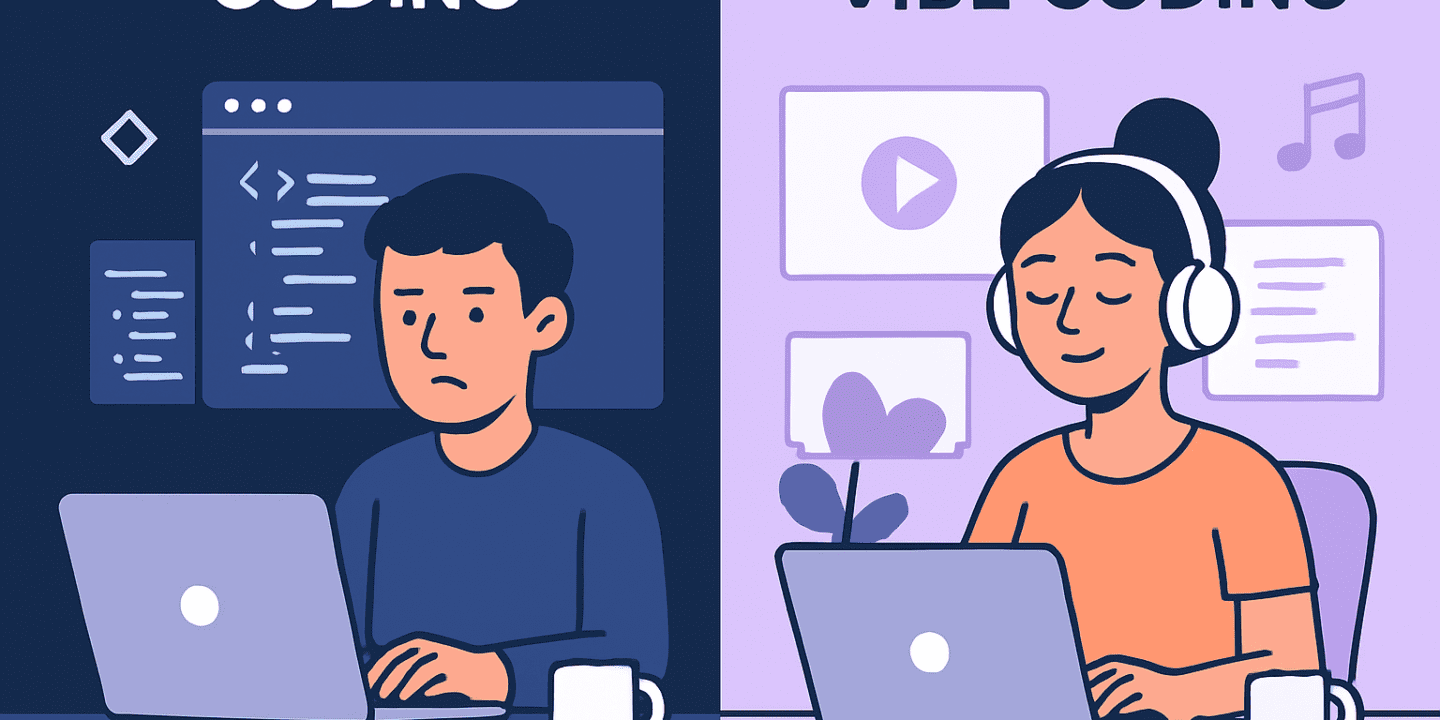
As a tech founder if you’ve spent time on tech Twitter or read recent startup blogs, you’ve likely seen the term “vibe coding.” Or maybe in your standup meetings, you keep hearing the engineering team talk about “vibe coding” and you are wondering if there is a secret coup in progress to remove you, because what exactly is vibe coding and how is it different from just coding? More importantly how can it benefit you as a non-technical startup founder leading a tech team?
In simple terms vibe coding is still coding, but in this case the developer describes an app/product idea in natural language, feeds it to an AI model, and the system generates most (or all) of the code and can even deploy it itself.
A lot of non-technical folks tend to confuse it with “AI-assisted coding” where the AI model merely suggests the code, but it is still the developer that does the work. In vibe coding, the AI takes the lead. The human developer just tests, describes, and refines the code until the product is good to go.
So Why Should You as A Nigerian Founder Be Excited About vibe coding?
For Nigerian founders under pressure to move fast and cut costs, vibe coding sounds almost magical. It promises faster MVPs, fewer developers, and quicker investor demos. And in a market where good developers are expensive or hard to retain, vibe coding is a life saver.
1. Speed to Prototype
Startups live or die by how quickly they test ideas and ship products. Vibe coding allows founders or product leads to describe an app in plain English — “Build a mobile wallet that lets users save in dollars and withdraw in naira” — and have a working prototype within hours.
For early-stage Nigerian startups trying to raise pre-seed funding or show proof of concept, this could be a game-changer.
2. Empowering Non-Technical Founders
Not every founder can code, but every founder has ideas. Vibe coding lets business-minded CEOs build mockups and test user experiences before hiring full teams. It gives founders a level of technical independence that can save months and millions in early product experiments. For an average Nigerian founder who hampered by lack of funds that idea is a godsent
3. Cost Efficiency
When used correctly, vibe coding can reduce the number of engineers needed at the earliest stages. Instead of hiring five developers for an MVP, a founder might work with one tech lead who manages AI-generated components. This is particularly attractive for Nigerian startups balancing small budgets with big ambitions.
4. Creativity and Experimentation
AI tools can generate features or interfaces that humans might not have considered. Founders can explore creative product directions faster and use the AI as a brainstorming partner — useful in sectors like fintech, edtech, or entertainment tech where innovation moves quickly.
Now that you know how useful vibe coding can be, I am sure you are already calculating how you can fire all your developers, vibe code your product yourself, and divert the millions in naira you pay them a month into another area of the business, but before you start making calls to your HR to start writing those dismissal letters, here are things you also need to know about vibe coding:
Vibe coding is not a substitute for traditional engineering discipline. If you, as a Nigerian founder, believe that you can “do without developers” you might end up with a product that is fragile, insecure, and unscalable.
1. Security and Quality Risks
AI-generated code can contain hidden vulnerabilities — from data leaks to poor encryption practices. Claude only knows code; it doesn’t understand the full security context of Nigerian fintech regulations (like CBN compliance or NDPR). Without skilled engineers reviewing the code, your product could expose user data or fail under real-world traffic. Don’t vibe code a product that will ensure that you can’t sleep in your house because EFCC is on your tail. A word is enough for the wise.
2. Maintenance Nightmares
AI can build but it cannot maintain what it builds. As your app grows, someone still has to fix bugs, optimize performance, and add features. Many vibe-coded projects collapse when they move from prototype to real-world use because there’s no consistent architecture or documentation. So make sure that your CTO is on hand to continually maintain the codebase otherwise you are On Your Own
3. Intellectual Property (IP) Concerns
If your product’s source code was generated by a third-party AI tool, who owns it? Depending on the AI provider’s terms of service, you may have limited rights to commercialize it. Founders in regulated industries (like finance, health, or government tech) must tread carefully. So, congratulations, you have now built an e-commerce platform that you can’t commercialize because the code doesn’t belong to you.
4. Weak Engineering Culture
Perhaps the most subtle danger is cultural. Over-reliance on vibe coding can discourage real engineering skill-building within your team. If your developers only “vibe” with AI outputs and never learn to reason deeply about code, your startup may scale with a weak technical foundation, and believe me it will cost you later, it has happened before.
Now you are confused again, if vibe coding creates so many problems why does anyone even bother to use it? For me it is all about balance. So how do you maintain balance in your vibe coding?
The key is to use it as something that makes your work faster, not a replacement for quality work done by a properly trained engineer.
1. Use It for Ideation and Prototyping
When you need to visualize a new feature, prepare an investor demo, or test a product hypothesis, vibe coding can be incredibly efficient. Treat these prototypes as throwaway versions — not the final product.
2. Always Have a Technical Gatekeeper
Even if you’re a non-technical founder, make sure there’s a lead developer or CTO who reviews all AI-generated code before it ships. They should handle architecture, testing, and deployment decisions.
3. Demand Documentation and Testing
Encourage your tech team to treat AI-generated code with the same rigor as human-written code. Insist on test coverage, peer reviews, and documentation. These steps prevent your product from becoming a “black box” no one understands six months later.
4. Encourage Learning, Not Laziness
If your developer vibe code with AI tools, make sure they’re learning from them — not outsourcing thinking to them. Teams should analyze why the AI generated a certain solution and improve on it. The goal is augmented intelligence, not blind dependence.
5. Balance Speed with Longevity
Vibe coding helps you move fast, but scaling a product requires strong systems and human insight. Once your idea is validated, invest in rebuilding critical components properly. Use vibe coding as a bridge, not a destination.
Final Thoughts: Founders Should Lead the “Vibe” Not Follow It
Vibe coding will not replace developers — it will redefine their roles. For Nigerian founders, this means learning enough about AI-assisted development to ask the right questions, set the right boundaries, and measure productivity meaningfully.
If you’re a CEO or founder, you don’t need to fear vibe coding. You need to manage it intelligently — as a new creative tool that can boost your team’s speed but still requires human oversight, strategy, and discipline.
In the end, technology doesn’t build great companies — people do. The vibe can help you move fast, but only a skilled team ensures you don’t break things permanently.






No Comments