



For more than a decade, venture capital has been treated as the ultimate badge of startup success across Africa. Founders celebrate funding rounds like championship wins. Headlines announce millions raised with the same excitement reserved for political victories or major sports triumphs. Investors fly in, conferences multiply, and pitch decks become as important as products.But beneath the glamour lies a difficult question many founders are now asking quietly: what if the venture capital model was never truly designed for Africa in the first place?As the dust settles from the recent startup funding slowdown across the continent, the cracks in the system are becoming harder to ignore. Startups once praised for rapid expansion are cutting staff, shutting down markets, or disappearing entirely. Investors who once pushed aggressive growth are now demanding profitability. The conversation has changed from “How fast can you scale?” to “Can this business actually survive?”This moment demands honesty. Africa does not have a startup problem. It has a capital model problem.
A Model Imported Without Translation
The traditional venture capital model was largely built in Silicon Valley, where the environment is uniquely designed for it to thrive. There is reliable power, strong consumer spending, deep financial systems, efficient regulation, and large pools of high-value customers who can adopt new products quickly.In that environment, the logic makes sense: invest heavily, scale fast, dominate the market, and either exit through acquisition or a public listing.Africa is a very different operating environment. Here, startups are often forced to solve infrastructure problems before they can even deliver their actual service. A fintech company is not just building payments; it is solving trust gaps, regulatory uncertainty, banking inefficiencies, and poor connectivity. A logistics startup is not simply moving goods; it is navigating bad roads, fragmented addressing systems, and unstable fuel costs. Growth here is not just about product-market fit. It is about survival against systemic friction.Yet many investors still apply Silicon Valley expectations to African realities.
The result is pressure to scale at unnatural speeds, often before the business foundations are strong enough.
Growth at All Costs, Until It Costs Everything
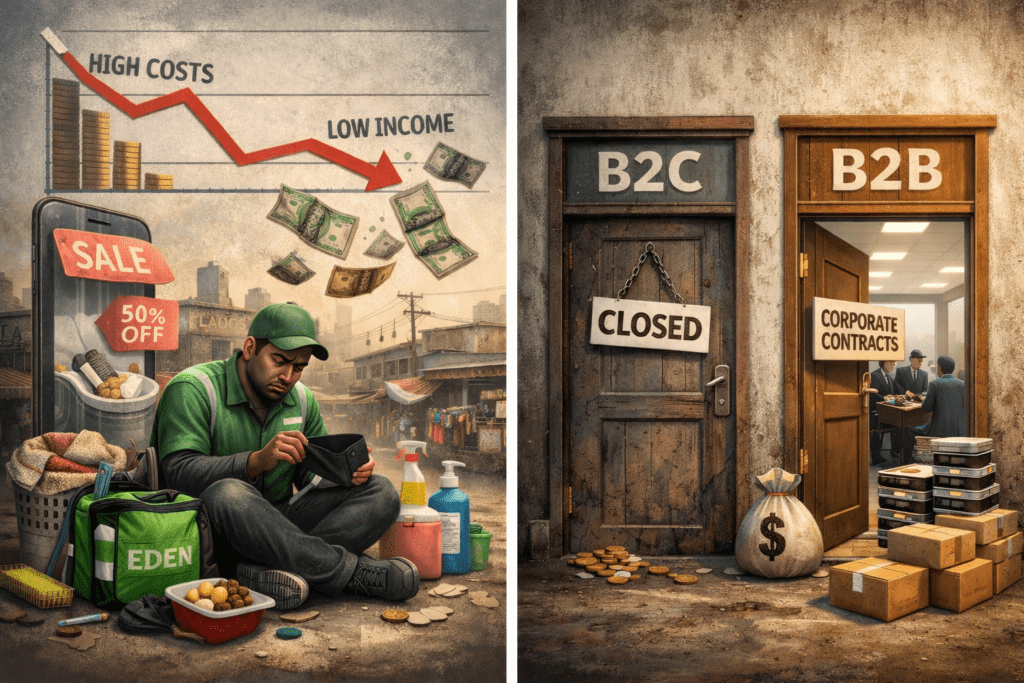
For years, “growth at all costs” became the dominant philosophy.Founders were encouraged to prioritize user acquisition over sustainable revenue. Burn rates were tolerated as long as the charts pointed upward. Market expansion was rewarded, even when local operations were still unstable.The logic was simple: dominate first, figure out profitability later.But later has arrived.Across the continent, startups that raised significant capital are now facing harsh corrections. Teams have been downsized. International expansion plans have been reversed. Some companies have quietly shut down after years of public praise.The issue was not always bad leadership or weak ideas. Often, it was a mismatch between the business model and the funding model.A startup solving long-term structural problems cannot always behave like a software company in California.Africa’s markets often require patience, trust-building, local adaptation, and operational depth. Venture capital often demands speed, aggressive returns, and quick exits.These two realities frequently collide.
The Exit Problem Nobody Talks About
One of the least discussed issues in African venture capital is exits. VC works because investors expect a small number of companies to generate massive returns through acquisitions or IPOs. That exit pathway is essential.But Africa’s exit ecosystem remains limited.There are fewer major acquirers. Public markets are not always startup-friendly. Regulatory systems can slow cross-border acquisitions. Large-scale liquidity events remain rare compared to the United States, Europe, or parts of Asia.This creates tension.Investors want venture-scale outcomes in markets where the exit routes are still developing. Founders are pushed to build for investor expectations rather than market realities.Sometimes the best business for Africa is not the best business for venture capital.A profitable, steady company serving a critical local need may create enormous social and economic value, but it may not deliver the explosive returns a VC fund requires.That does not make it a bad business. It simply means it may need a different kind of capital.What Africa Actually NeedsAfrica does not need less capital. It needs smarter capital.Patient capital. Revenue-based financing. Strategic corporate investment. Blended finance. Local institutional investment. Founder-friendly debt structures. Government-backed innovation funding. Long-term ecosystem builders rather than short-term valuation hunters.Not every startup should be forced into the VC pipeline.Some businesses need capital that understands infrastructure cycles. Some need financing models tied to cash flow, not just equity dilution. Some need partnerships, not just pitch competitions.There is also an urgent need for stronger local investors who understand the nuances of the markets they are funding.Too often, African founders build for foreign investor approval instead of customer relevance. They optimize for what sounds investable in London or San Francisco rather than what creates durable value in Lagos, Nairobi, Accra, or Kigali.That must change.
Redefining Success
Perhaps the biggest shift needed is cultural.Funding should not be confused with success.A headline announcing a $10 million raise is not proof of product quality, business strength, or long-term value. It is simply proof that investors made a bet.Real success is building something that lasts.A profitable business with strong retention, trusted customers, and healthy operations should command more respect than unsustainable growth dressed up as innovation.
Africa’s startup ecosystem must move from performance metrics designed for investor presentations to value metrics rooted in real economic impact.How many jobs were created?How many systems were improved?How much local resilience was built?How sustainable is the model without constant external funding?These are harder questions, but they matter more.
Beyond Imported Playbooks
Africa’s innovation future will not be built by copying Silicon Valley templates and hoping they fit. It will be built by designing systems that reflect African realities.That includes capital.The goal should not be to reject venture capital entirely. VC has played an important role in accelerating innovation across the continent. But it should be treated as one tool, not the default destination for every founder.Because when the wrong capital meets the right business, both can fail.The next generation of African entrepreneurship must be built on models that value resilience as much as scale, sustainability as much as speed, and long-term relevance as much as short-term returns.The venture capital model was not built for Africa.The real opportunity now is to build one that is.
