

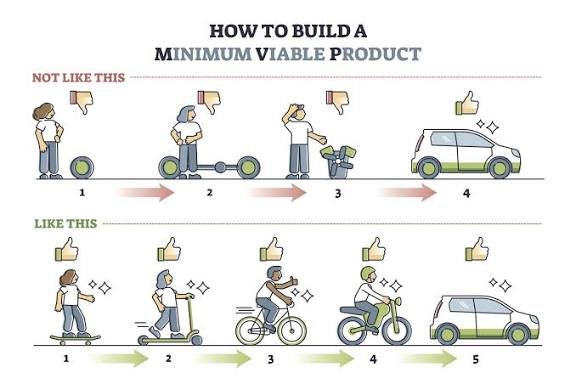
In Nigeria’s rapidly evolving tech ecosystem, founders often face a tough paradox: you need money to build your product, but you need a product to be able to attract investors. With the rising cost of resources, inflation, and intense competition, Every startup has to learn how to build a Minimum Viable Product (MVP) as a matter of survival. Chika Uwazie, Co-Founder at Afropolitan Nation, points out that In a country like America, many startups die because too much money causes them to lose track of their priorities, but in Nigeria, Many of Nigeria’s most successful tech startups had to start with lean MVPs, built with clarity, discipline, and resourcefulness as a matter of necessity. So if you’re a Nigerian tech founder looking to build something users love without burning cash, here is something that you need to know .
Start With a Hypothesis, Not a Product
The biggest mistake you can make as a founder is to start product development without validating market assumptions. Your MVP should be a test of one thing: are you solving a real problem that people have and will pay to solve?
If you want to know how to test for a real problem you can create a startup for here is an easy way to do it:
– Interview at least 10–20 potential users.
– Ask about their current solutions, not what they wish existed.
– Identify the highest-friction point in their workflow.
This approach ensures your MVP is rooted in user reality—not in founder fantasy. It also reduces time wasted building unnecessary features.
Define a Skinny, Not Starving MVP
A skinny MVP delivers core value with minimal fluff. A starving MVP is so bare that users find no value in it. Striking the balance is crucial.
To define your skinny MVP, ask:
– What is the single action users *must* complete to get value?
– What features are necessary for that action to succeed?
– What features can be added later?
For example, a company like Gigbanc which built a fintech app for freelancers first focused payments and invoicing, then analytics analytics, community, and portfolio tools came later once the product got traction. Prioritization saves money and speeds up validation.
Use No-Code and Low-Code Tools First
Thanks to the leverage created by Artificial Intelligence, Nigeria has one of Africa’s fastest-growing low-code/no-code adoption curves—and for good reason. These tools drastically cut development time and cost. Now there is no excuse for not getting your MVP up to scratch in a timely manner
Some great options:
– **Bubble / Adalo** for web and mobile apps
– **Glide** for internal tools
– **WordPress + Plugins** for marketplace-style MVPs
– **Zapier / Make** for workflow automation
– **Airtable / Notion** for databases
Outsource Smartly—But Don’t Abdicate Control
Nigerian founders often hire developers too quickly or too cheaply, resulting in:
– over-engineered products,
– poor code quality,
– delays, or
– burnout.
Instead:
– Hire freelance developers for *specific* tasks only.
– Use clearly written feature requirements.
– Pay based on milestones, not promises.
– Use code-review platforms or advisors to check quality.
Alternatively, collaborate with junior developers who need experience—offer equity or certificates, but make sure expectations are clear.
Build With Ready-Made Infrastructure
The good thing about the tech ecosystem nowadays is that for every tech solution, you have getting a system that already does it on a larger scale is only a click or a tap away. There is absolutely no need for you to reinvent login systems, payment rails, notifications, analytics, or hosting. Today’s tech stack allows you to assemble infrastructure like Lego bricks.
Examples:
– **Firebase** for authentication and real-time database
– **FlutterFlow** for rapid mobile app development
– **Paystack / Mono / Stitch** for payments & financial data
– **Vercel / Render** for affordable cloud hosting
– **Supabase** for backend services
Start with free tiers but upgrade responsibly—remember, your MVP’s purpose is validation, not perfection.
6. Test Early, Test Fast, Test Cheap
A scalable MVP requires brutal honesty. Push it to real users as soon as possible. Nigerian founders often delay launch due to fear of criticism—but feedback is your fuel.
Use:
– social media polls,
– WhatsApp groups,
– beta cohorts,
– small controlled user groups (e.g., 10–50 people).
Track:
– Are users completing key actions?
– Where do they drop off?
– What confuses them?
– What are they hacking around your tool?
This data should guide your next iteration—not your assumptions.
7. Monetise Early (Even if It’s Small)
A Nigerian startup that earns ₦50,000 in month one is already ahead of many beautifully polished but revenue-less apps. Monetization isn’t just about money—it’s validation.
Ask:
– Will people PAY (not say they *will pay*) for this?
– What is the smallest thing you can charge for?
– Can you start with pre-orders, credits, or subscriptions?
Revenue—even tiny amounts—makes you more attractive to investors and helps sustain development.
8. Build for Scale From Day One, But Don’t Over-Engineer
Scalability doesn’t mean building for 1 million users upfront. It means choosing tools, architecture, and processes that can grow *when needed*.
Practical tips:
– Use modular design so you can swap components later.
– Document everything to avoid chaos.
– Standardize naming conventions.
– Avoid custom solutions unless absolutely necessary.
These small decisions save huge refactoring costs later.
9. Grow With Community, Not Just Ads
If you’re building in Nigeria, marketing spend can drain your budget fast. Instead, lean into community-driven growth:
– Start a waitlist.
– Share your journey on X or LinkedIn.
– Build an audience on TikTok or YouTube.
– Host AMAs or Twitter Spaces.
– Partner with micro-influencers.
Community-backed products grow faster and more cheaply.
10. Know When to Pivot or Kill the MVP
Not all MVPs become startups—and that doesn’t mean you have failed or you can’t have any better ideas. The goal is learning, not ego.
Consider pivoting if:
– users repeatedly reject the core value,
– you cannot solve the problem affordably,
– new insights reveal a bigger opportunity.
Knowing when to stop saves time and money—and may lead you to your next successful idea.
—
Final Thoughts
Building a scalable MVP on a small budget in Nigeria isn’t just possible—it’s the norm for most successful founders. The key is discipline: validate first, build lean, monetize early, and iterate fast. If you can master these principles, your MVP can become a real business long before you spend big money.

One reply on “How to Build a Scalable MVP With a Small Budget”
[…] I was writing this piece on how to build a scalable Minimum Viable Tech Product on a budget, I realized that the most common examples of the products that Nigerian tech startups used are […]