



On July 1, 2026, the CBN revoked the 46 microfinance bank licences in a single sweep. The stated reason was regulatory failure. The unstated problem is what those banks were supposed to be doing and what happens to the people they were doing it for.
There is a particular kind of financial institution that does not make headlines when it opens but makes a specific kind of silence when it closes. Not the silence of a headline or a press conference but the silence of a market stall that cannot get a loan to restock, of a small contractor who cannot make payroll, of a rural community where the nearest alternative bank is a bus ride and half a day’s wages away.
On July 1, 2026, the Central Bank of Nigeria revoked the operating licences of 46 microfinance banks across the country, citing a range of regulatory failures that rendered the affected institutions unfit to continue operating as licensed financial intermediaries. The affected banks, located across Lagos, Kano, the FCT, Abia, Ogun, Kaduna, Niger, Plateau, Rivers, Bayelsa, Benue, Cross River, Delta, Kebbi, Kwara, Ondo, Osun, Oyo, and Anambra states, span 19 states and cut across all tiers of the microfinance banking licence structure.
On its face, the action is defensible. A bank that cannot cover its liabilities is a risk to the people whose savings are inside it. A bank that stopped operating years ago and never told the CBN is not a bank at all, it is a liability wearing a licence. Cleaning these out of the register is what a functioning regulator is supposed to do.
But the timing, the geography, and the absence of a clear transition plan for the communities these institutions served all point to a question that Nigeria’s financial regulators have not yet answered honestly: if microfinance banks are the primary mechanism for reaching the Nigerians that commercial banks and digital fintechs have not reached, what happens to financial inclusion when you close 46 of them at once?
The Sector They Were Meant to Serve
To understand what is at stake here, it helps to understand who microfinance banks actually serve because the answer is not who most people in Lagos’s tech conversation picture when they think about “banking the unbanked.“

CBN Office
A microfinance bank is a regulated financial institution created to serve people and businesses that conventional banking models have historically overlooked. In Nigeria, these institutions focus on the underbanked, including micro-entrepreneurs, artisans, traders, farmers, salary earners, and low-income communities that may lack the documentation, collateral, or transaction history required by larger banks. They are not competitors to Access Bank or Zenith. They operate in an entirely different register and they are often in communities where the nearest commercial bank branch is in a different local government area and where a ₦50,000 loan to a seamstress or a vegetable seller is a consequential financial decision that no tier-one bank would process.
Nigeria’s financial inclusion rate reached 74% in 2023, up from 64% in 2020. That is genuine progress. But the CBN’s own PSV 2028 framework targets 95% financial inclusion by 2028 — which means Nigeria needs to bring in the remaining 26% of its adult population within two years. That 26% is not lightly unbanked. These are, by definition, the people that every previous wave of financial inclusion effort, commercial bank expansion, agent banking, mobile money, and fintech apps did not reach. They are the people microfinance banks were specifically designed and licensed to serve.
Closing 46 of those institutions on the first day of a new financial year, spanning 19 states, without a replacement plan, is not a neutral event in that context. It is a subtraction from an equation the CBN itself has publicly committed to solving.
What the Depositors Are Owed and What They Will Actually Get
The regulatory sweep triggered a frantic scramble among depositors. The NDIC moved quickly, the corporation has been formally appointed as the official liquidator of the failed financial institutions and has commenced the process of orderly closure, including the immediate takeover, verification, and payment of insured sums to eligible depositors.
The insured sum is the number that matters most here, and it is worth being specific about what it means. Depositors of microfinance banks are entitled to a maximum insured sum of ₦2 million. Once a bank’s licence is revoked, the NDIC pays the insured amount using depositors’ Bank Verification Numbers to locate and credit their accounts in other banks, without requiring physical visits. The NDIC has also improved its speed: although the law allows 30 days for reimbursement, the NDIC now aims to pay insured deposits within 72 hours after licence revocation, using BVN and the Nigeria Inter-Bank Settlement System.
That is, on paper, a significant improvement on what existed before. The ₦2 million cap is also higher than it once was. But the cap is also where the protection ends. Although the NDIC compensates depositors, it is not always 100 per cent of their funds. Creditors are usually settled first, followed by depositors, while shareholders are often the last to be considered. Any depositor holding more than ₦2 million in one of these institutions — a small business owner, a cooperative, a community savings group — enters a liquidation queue with no guaranteed timeline and no guaranteed outcome.
The 72-hour payment claim is also, so far, an aspiration applied to larger institutions. The NDIC paid Heritage Bank depositors within four days; Union Homes and ASO Savings within 72 hours. Whether that speed holds across 46 simultaneous closures, many of them in states with weaker BVN penetration and more fragmented record-keeping than their Lagos-based counterparts, is a different question entirely, one the NDIC has not yet answered publicly.
The Geography of This Purge
The geographic detail in this story deserves more attention than it has received. Thirteen of the 46 revoked licences belong to banks in Kano alone — Zain MFB, Bompai MFB, Ajwa MFB, Now Now Digital MFB, Minjibir MFB, Shanono MFB, Sumaila MFB, Rimin Gado MFB, Sycamore MFB, Tofa MFB, Kanopoly MFB, Bellbank MFB, and Esteem MFB.
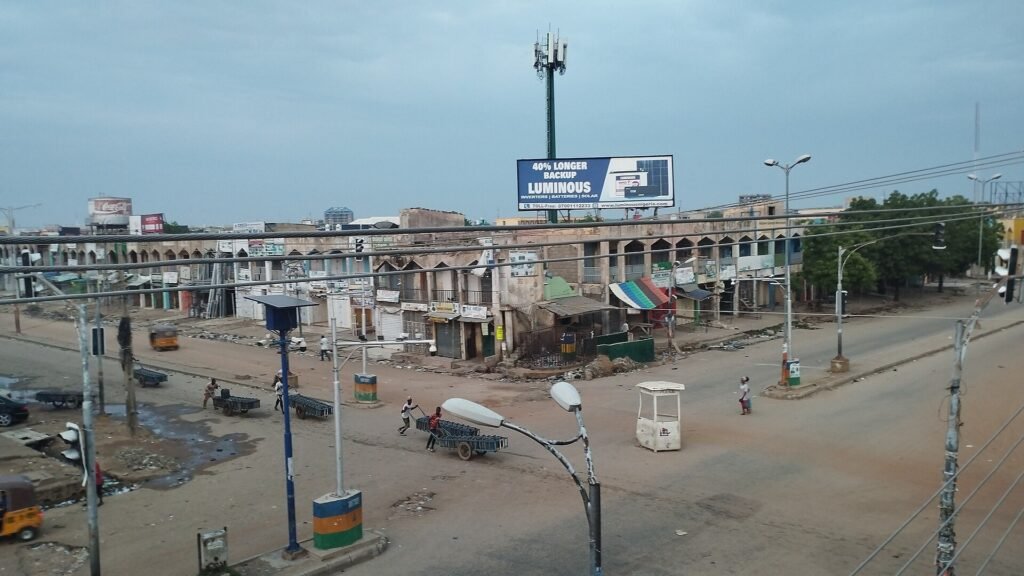
Sabon Gari Market, Kano (Image by Gwanki—Own work, CC BY-SA 4.0)
Kano is Nigeria’s second-largest city and the commercial centre of the north, a region where formal financial infrastructure has historically been thinner than in the south, where gender gaps in financial inclusion are wider, and where microfinance banking has played a proportionally larger role in local economic life than in Lagos or Abuja. Losing 13 institutions in a single regulatory action in a single state is not a system-wide correction. It is a concentrated shock to a specific geography that was already operating with less financial infrastructure than the cities where this story is being written and read.
The President of the Bank Customers Association of Nigeria made the structural point plainly: “The economy, of course, would also have to suffer for it because the roles they have been playing within the economy, they will no longer play those roles.”
That observation is obvious, but it needed to be said because the CBN’s statement, for all its careful legal language about safeguarding stability and protecting depositors, did not say it.
When the Digital Bet Fails
Among the 46 revoked licences are names that belong to a specific moment in Nigeria’s fintech history, the 2020–2022 wave of startups and payment platforms that decided the microfinance banking licence was the unlock they needed.
Ourpass, formerly known in fintech circles as a merchant-facing payments startup before pivoting to a microfinance banking model, is among those that have had their licences cancelled. Creditville MFB, a Lagos-based consumer lending platform, also appears on the list. Now Now Digital MFB, a Kano-based digital microfinance bank, is another notable name given the broader industry conversation about the viability of digital-first models outside major urban centres.
The logic of the pivot was never irrational. A payments company with a microfinance licence could hold deposits, offer credit, and build a more defensible business than a pure-play fintech operating under tighter restrictions. The CBN actively encouraged the sector’s growth during this period. Many of these companies went through the full licensing process, met the original capital requirements, built product, and acquired customers.
What changed was the recapitalisation threshold and the economic environment in which they were expected to meet it. The microfinance sector has grappled with insufficient capital, poor corporate governance, and depreciating loan portfolios amidst persistent inflation and high interest rates. A digital MFB that was adequately capitalised in 2021 naira terms may not have been adequately capitalised in 2024 naira terms not because it was mismanaged, but because Nigeria’s inflation between those two years eroded the real value of its capital base in ways that a static threshold cannot account for.
This is not an argument for keeping insolvent institutions open. It is an argument for asking whether the CBN’s recapitalisation timeline was designed with any consideration of the macroeconomic conditions in which these institutions were being asked to recapitalise or whether it was set, and then enforced, without that context.
The Question That Hasn’t Been Asked
Nigeria’s regulators have become more active and more decisive in the past two years. The CBN under Cardoso has moved on to recapitalisation with a firmness that his predecessors did not consistently demonstrate. The NDIC has genuinely improved its depositor response time. These are not trivial things in a country where regulatory forbearance has, historically, allowed weak institutions to persist long past the point where intervention would have been less painful.
But regulatory decisiveness and regulatory strategy are not the same thing. Closing institutions that have failed is a function of good supervision. Having a plan for what fills the gap they leave behind is a function of good policy. The CBN’s statement on July 1 addressed the first in careful detail. It did not address the second at all.
Nigeria has committed, publicly and in its own policy framework, to bringing 95% of its adult population into formal financial access by 2028. The people furthest from that target are in the rural north, in the semi-urban south, in the communities where a microfinance bank was often the first formal financial institution anyone had ever walked into — are the exact people that 46 fewer institutions are no longer serving this week.
That gap does not fix itself. Digital fintechs will not spontaneously expand into Tofa or Shanono. Commercial banks will not open branches in Minjibir. Agent banking networks, where they exist, offer transaction processing — they do not offer credit. The credit is what disappears when a microfinance bank closes, and credit is what a trader needs to restock, a farmer needs to plant, a seamstress needs to buy fabric before she can sew anything to sell.
The CBN cleaned the register. What it has not yet shown is a plan for what gets built on the land where those 46 institutions used to stand. Until it does, the 95% target is not a policy commitment. It is an aspiration written above a subtraction that nobody in the policy conversation wants to talk about.

Abia
Anambra
BVNK
CBN
digital fintech
FCT
Financial inclusion
Kano
Microfinance Banks
NDIC
Nigeria
Osun
Oyo
Tofa MFB