



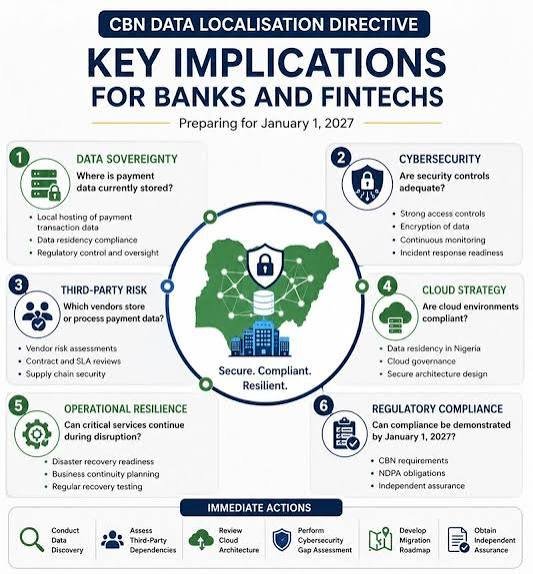
There is a date circled on every compliance calendar in Nigeria’s financial technology sector right now: January 1, 2027. That is the deadline the Central Bank of Nigeria has set for all banks, fintechs, mobile money operators, switching companies, and payment service providers to ensure that transaction data generated within the country is stored and managed on local servers.
The directive, contained in a circular signed by Rakiya Yusuf, Director of the CBN’s Payments System Supervision Department, introduces new market structure requirements, data localisation rules, ultimate beneficial ownership disclosure obligations, and systemic oversight measures for payment system participants. For an ecosystem that has grown accustomed to the flexibility of global cloud infrastructure, this is not a minor adjustment. It is a full structural reset and it is consequential across compliance, investment, infrastructure, and competitive dynamics.
The Regulatory Logic
The CBN’s position is grounded in a straightforward concern: while growth in digital payments has improved innovation, efficiency, and financial inclusion, it has also created concerns around market concentration, operational dependence, ownership transparency, and the storage of critical payments data.By mandating local storage, the apex bank gains something it has long lacked, direct, unmediated visibility into the payment flows that increasingly power the Nigerian economy. The move is intended to strengthen data security, improve regulatory supervision, and ensure quicker access to financial information for monitoring and investigative purposes. Compliance is not optional, and the CBN has warned it will closely monitor compliance and impose sanctions where necessary.The policy also arrives in a wider context. The initiative mirrors a growing global trend among regulators seeking to localise critical financial data and reduce dependence on offshore infrastructure. Nigeria is not the first to move in this direction, and it will not be the last.
The Infrastructure Opportunity
Strip away the compliance pressure and what remains is a significant commercial signal. Every major digital infrastructure market ultimately depends on workload concentration. Data centres, cloud platforms and interconnection ecosystems become viable when enough applications, services and users operate within a given market.By mandating that payment data remain within Nigerian borders, the CBN has effectively created a guaranteed pool of domestic demand. The payments sector represents one of Nigeria’s largest and fastest-growing sources of digital activity. Banks, fintechs, payment processors, switching companies, mobile money operators, and digital financial platforms generate enormous volumes of transaction data every day. Directing those workloads to stay local provides the kind of demand certainty that data centre investors and local cloud operators have historically struggled to attract.For data centre operators in Nigeria, this directive is a significant business opportunity. Banks and PSPs that currently store data on foreign cloud servers will need to migrate to local infrastructure before January 2027. For local hosting providers and cloud infrastructure players with Nigerian operations, the window between now and the deadline is as much about capturing market share as it is about building capacity.
The Compliance Challenge
But as positive as the directive may look, it is not all sunshine and roses however, whatever optimism it engenders must be weighed against a harsh reality. The move is raising concerns among fintech executives over infrastructure readiness, migration risks, costs, and whether local data centres can reliably support payment systems. These are not abstract concerns. Nigeria’s data centre landscape, while growing, has not historically been tested at the scale and reliability that the payments industry demands. Power supply, uptime guarantees, and latency requirements are all live questions.
Furthermore banks, payment service providers, fintech companies and technology vendors may need to review their data architecture, migrate systems to domestic infrastructure, and strengthen local hosting capabilities ahead of the compliance date. For large banks with legacy infrastructure, that is a complex and expensive undertaking. For smaller fintechs operating on lean margins, the capital outlay could be existential.
The ownership transparency dimension adds another layer. For foreign-backed players like Flutterwave and Paystack, the beneficial ownership requirement is particularly relevant. Both are ultimately controlled by foreign investors and will need to be fully transparent about that ownership structure, all the way up to the ultimate beneficial owners — not just at the level of their Nigerian operating entities.
The Concentration Question
Beyond data, the CBN has also introduced market concentration caps with direct consequences for competitive dynamics. No single institution can dominate both major ends of the card payment chain at the same time. Any institution controlling more than 25 percent of the card issuing market will be restricted to no more than 15 percent of the merchant acquiring market.For dominant payment players, this represents a ceiling. For smaller and mid-tier operators, it opens a door. If dominant players are forced to pull back in certain segments, space opens up for others to grow. The monthly market share reporting the CBN is mandating will also give the regulator visibility to detect if smaller players are being squeezed out of the market unfairly.
The Test That Matters
Ultimately, the most honest question about this directive is not whether it is the right policy, it probably is, but whether it will be enforced with consistency. The CBN has a track record of issuing strong directives and then enforcing them unevenly. The December 2026 and January 2027 deadlines will be the true test of whether this circular has real teeth or becomes another regulation that is honoured mostly in the breach.What the CBN issued is essentially a maturity test for the industry. The message is clear: the era of building fast and figuring out the regulatory details later is over. Nigeria’s payment infrastructure must now be transparent, locally accountable, and resilient enough to withstand scrutiny.For the Nigerian tech ecosystem, that is both a challenge and, if executed well, a genuine inflection point.
