



On 29th May 2026, Nigeria’s Minister of Defence, General Christopher Musa, made a statement that should trouble anyone paying close attention to how this country is governed.
“We must have a database as Nigerians,” he said during an interview on Arise News, arguing that comprehensive biometric records and organised data systems are essential for tracking criminals, both within Nigeria and abroad. “With the database, if you go abroad, and you commit an offence, it’s very easy for them to arrest you. It’s not by magic,” he said, warning that failure to act on this would continue to “haunt” the country. Again, on the 13th of June, 2026, while speaking at the Nigerian People’s Strategic Conference and Defence Exhibition 2026, he asserted again that “We are struggling because we do not have a proper database.” He claimed that modern criminal networks are exploiting these gaps to evade security agencies.
On its face, this is a reasonable position. Modern security infrastructure depends on data. No serious nation fights crime, terrorism, or cross-border offences without organised records of who its citizens are. The Minister is right about the principle.
But the statement raises an uncomfortable question that deserves honest scrutiny: does Nigeria not already have such a database?
The Database That Already Exists
It does. Nigeria’s National Identity Management Commission has been running the Digital Identity for National Development project since 2020, with total funding of $430 million co-financed by the World Bank, the French Development Agency, and the European Investment Bank. NIN registrations, which link demographic data with fingerprints, facial images, and signatures, stood at 121 million as of June 2025.
This is not a small undertaking. It is one of the largest biometric identity programmes on the African continent, built over more than a decade, with hundreds of millions of dollars in international financing and a presidential directive mandating its use across government agencies for identity verification and security purposes.
So when a senior cabinet official, responsible for national security, calls for the establishment of “a database” as though Nigeria were starting from zero, one of two things is true. Either the existing system is so disconnected from the security architecture that those overseeing national defence do not consider it usable for their purposes, or there is a troubling gap in awareness at the highest levels of government about what Nigeria has already built and paid for. Neither possibility is comforting.
What the Existing System Actually Looks Like
The honest answer likely sits between the two. Nigeria’s identity database exists, but its usability has been undermined by years of operational dysfunction. NIMC’s verification portal underwent a system migration beginning in July 2025 that was intended to strengthen national security, yet the resulting downtime persisted for months, with users unable to access modification, verification, and authentication services.
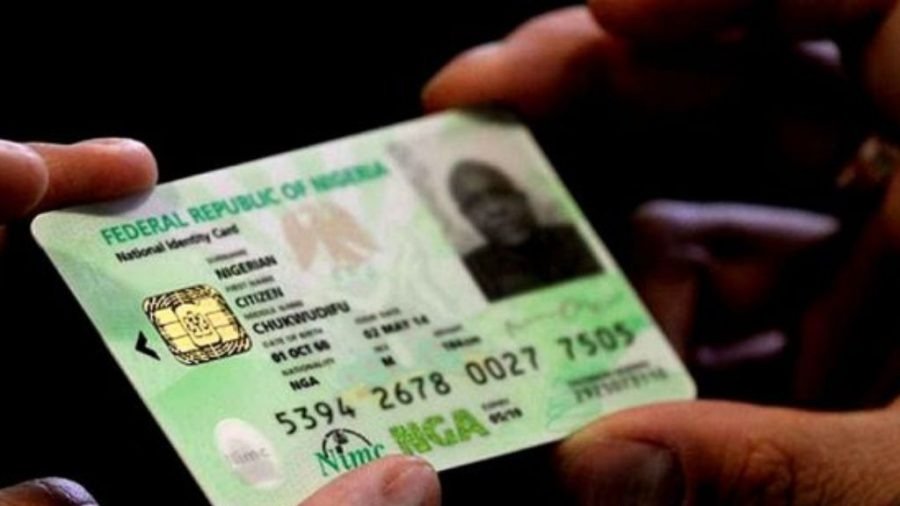
A NIN Card (Image Source: Google)
Nigerians who update their personal information through NIMC frequently find those changes do not reflect in their bank records, with both NIMC and the banks blaming each other for the disconnect. As recently as June 2026, NIMC’s own Director-General was forced to order a security audit of all vendors connected to its infrastructure, citing rising concerns about data breaches, phishing, and illegal sites impersonating the NIN portal.
In other words, Nigeria does not lack data. Nigeria lacks a functioning, interoperable system that turns that data into something security agencies can actually use in real time. The Minister’s statement, then, is less a call to build something new and more an unintended admission that what exists has not been integrated into the country’s security apparatus in any meaningful way.
A Smaller Country, A Sharper Database System
For perspective, consider Rwanda – a country with a GDP roughly one-twentieth the size of Nigeria’s and a population of around 14 million compared to Nigeria’s over 200 million.
Rwanda launched its Single Digital ID system in 2024 as part of a national digital transformation strategy, designed to unify citizen records and enhance access to both public and private services. The system incorporates iris scans, fingerprints, and facial data to support secure authentication, issued through a physical smart card, a virtual digital ID, and a unique personal identification number.
The entire project is estimated to cost around $38 million on completion — a fraction of the $430 million already committed to Nigeria’s identity programme. Rwanda is targeting full rollout by 2027, with the credential becoming the primary authentication tool for accessing services across government and the private sector – explicitly including national security functions.
The contrast is not about which country has spent more. It is about execution. Rwanda, with vastly fewer resources, appears positioned to deliver a system that functions as a single, authoritative source of identity for security and service purposes. Nigeria, with more than ten times the financial investment, is still managing portal outages, fragmented records between agencies, and a security establishment that, by its own Minister’s account, does not feel it has the database it needs.
That gap should give every Nigerian pause. This is not a resource problem. It is a coordination and execution problem — and those are, in some ways, harder to solve than writing a cheque.
What Should Happen Next?
The path forward does not require Nigeria to start over. It requires Nigeria to finish and to integrate what it has already begun.
First, the National Security Adviser’s office and NIMC need a formal, working data-sharing protocol that gives security agencies real-time access to the NIN database for legitimate law enforcement purposes – something that, if it exists on paper, clearly does not exist in practice if a Defence Minister is publicly calling for a database that already holds records on 121 million citizens.
Second, the interoperability failures between NIMC, the banking sector, immigration, and law enforcement databases need a dedicated resolution timeline, not another presidential directive that goes unenforced. As one recent analysis put it, Nigeria’s challenge is not a technical failure but a design governance failure, the result of agencies that are not governed by a citizen-first, security-first data principle.
Third, Nigeria should look seriously at the open-source identity platforms that countries like Rwanda and others are now adopting, which allow for faster, cheaper integration across government systems without the years-long procurement cycles that have historically slowed NIMC’s progress.
Nigeria has the talent. It has, on paper, the resources. What it appears to lack is the institutional discipline to connect what already exists into something the people responsible for the nation’s security can actually rely on. That is not a shameful admission to make. But it is one that needs to be made honestly — and addressed with urgency — before it continues to “haunt” the country, exactly as the Minister warned.
